
Finally, this Overview
Finally, this Overview
Introduction 15 September 2026, 10 am

Studio Caruso Archive, Various Authors, 2011-2026
In this last year of the Chair, we will look back with fresh eyes at fifteen years of research and design work. We will reflect on our archive, the collective endeavour of around a thousand students, and see what happens when the Palais Royal meets Sophie Calle, and when the Bank of England meets Theaster Gates. With invited collaborators and using new tools, this year we will take full advantage of finally having this overview.
This semester we will work on a large site in Zurich that while part of the city’s public infrastructure has always been a territory with limited public access. A place where the slaughter of animals and the distribution of meat will soon end, and public conversations within the local neighbourhood have already begun about imagining the future of this place. The city is assessing the heritage values of the site, and its economic and programmatic potential. For us, the future of the Schlachthof is an opportunity to heal the difficult karma of the site and to imagine what the civic could mean in a future when different actors, and not just humans, are given agency, where diverse ideas of programme and not just those of production, are allowed to flourish. We are interested in arranging the site in looser and more iterative ways so that new uses and constituencies can be accommodated as they emerge as part of an ongoing process. The mosque, the hospice, the caravanserai were places of care and exchange where society would both arrange and represent itself, where space became civic. Can we imagine the grand hall, the access yards, and the warehouses of the Schlachthof becoming locations for pleasure, care, propinquity and for the enactment of new kinds of civic life in Zurich.
Construction and writing as integrated disciplines are included in this course.
11 September 2026, 11:00 am, Pierre Huyghe Exhibition, Fondation Beyeler
15 September 2026, 10:00 am, Studio Introduction, ONA E30
HS 2026, ETH Zürich, Studio Caruso
Emilie Appercé, Tibor Bielicky, Adam Caruso, Anna Clocchiatti, Florian Kilian Jaritz
The City in the City
Seminar Week: October 19–23, 2026

İstanbul, Matrakçı Nasuh, 1537
Byzantium, Constantinople, Istanbul… all cities whose complex histories can still palpably be felt as part of the present. An ever-expanding settlement, this was the capital for three empires, both trade route and centre. For much of its history this has also been a place of diversity and tolerance, a place with many languages that welcomed foreigners to become part of its heady demographic mix.
We will travel to these cities on the Bosphorus to visit both the sites of empire and the fleeting places of everyday life. With the guidance of local colleagues, we will engage with narratives that span the social, the political and the material, looking beyond the surface to understand how the present and the future are inextricably bound up with the residues of history.
Cost category C (501–750 CHF), 16 students. The fee includes accommodation, local transportation, two dinners, entrances and the reader. Travel to and from Istanbul is not included and must be arranged individually.
HS 2026, ETH Zürich, Studio Caruso
Emilie Appercé, Tibor Bielicky, Adam Caruso, Anna Clocchiatti, Florian Kilian Jaritz


Zurich Monuments
Final Discussions & Exhibition
May 27, 2026

Franck Ducotterd, Matteo Rezzonico, Nien-Hsin Lu


Wednesday, May 27th, Exhibition & Discussions, ETH Zürich, ONA E30, 09:00 – 18:00
Guests: Marianne Burkhalter, Susan Hefuna, Sam Porritt


The Pleasure in Small Things
Final Discussions & Exhibition
December 16, 2025


Tuesday, December 16th, Exhibition & Discussions, ETH Zürich, ONA E30, 08:00 – 19:00
Guests: Monster Chetwynd, Pierre Chèvremont, Tuukka Laurila, Nora Walter
Restaging – Reimagining: Exhibition and Discussions
October 15, 2025

Group A


Wednesday, October 15th, Exhibition & Discussions, ETH Zürich, ONA E30, 10:00 – 17:00


Diploma FS 2026
Architecture School

Dance Deck, Kentfield California, Anna Halprin 1954


The FAU (1969) designed by Vilanova Artigas was an expression of the radical Paulista architecture school of the 1960s, and Gund Hall (1972) designed by John Andrews had similar grand ambitions. The HIL building tells a very different story, accidentally becoming the department of architecture when the ETH administration decided it was best to remove architecture students from the city centre where they had become too involved in the youth protests of the 1970s. The ugly brown building has never been much of an expression of our school’s desires.
This semester we will use the diploma project to explore how the HIL building can be re-structured to be a base for the department, and a more hospitable and sustainable place to meet and work. Since it is unlikely that the present labyrinth could be improved by enlargement, our efforts will be to concentrate the existing, making it lighter, clearer and more flexible.
We will also study examples of more dispersed and non-institutional learning, like Anna Halprin’s Dance Deck and Thomas Hirschhorn’s Gramsci Monument, places that demonstrate how learning can be more flexible and responsive to both its students and to ever changing educational contexts. We will combine the idea of a central base with mutable cells, spaces in and around the city that can more closely engage with the diverse people and situations of Zurich and beyond. By working both with the centre and the non-centre, perhaps we can start to imagine an architecture school fit for the 21st century.
We will continue to collaborate with Newrope in three ‘rooms of entanglement’, workshops where content, process and place are considered in an expanded forum.
Preparation phase:
-study of alternative places of education and the preparation of journals that compile the sites, programmes and central qualities of these open and more flexible schools.
-preparation of glossaries of learning.
-preparation of atlas of the HIL building and of possible non-central sites for the future department of architecture.
Elaboration phase:
-development of specific design proposals that incorporate new programmes and ideas of learning for the new department of architecture.
Diploma, FS 2026, ETH Zürich
Chair Caruso
Emilie Appercé, Tibor Bielicky, Adam Caruso
Newrope
Ellena Ehrl, Freek Persyn
The Village


Diploma FS 2025


Linthal, located at the end of the Glarus valley, carries a rich agricultural and industrial heritage that is still visible in its built environment, marked today by many underused or vacant buildings. Once a vibrant rural hub, it now bears the character of a transit zone, with essential services found only further down the valley. Yet within this apparent emptiness lies the potential for renewal. The unique landscape and close-knit scale of the village invite new ideas for how people might live, work, and engage with nature. Linthal is not defined by the anonymity of cities but by community spirit, resilience, and a deep connection to the land. Qualities that can become the foundation for a future shaped by sustainable agricultural practices and a strengthened rural collaboration.
In order to create and maintain such a regenerative farming concept a new actor is introduced that concentrates the responsibility for administrative and organizational as well as distributary questions in one figure. Various agents are part of a regenerative farm and ask therefore for the orchestration of the system cycles. With the One Roof Cooperative a contact point occurs. Combining two associations under one large roof: the farmer’s and the gardener’s association, the cooperative fosters dialogue, support, sharing and negotiations. Located in a former farmhouse, it connects Linthal’s traditions on several levels. Remnants in the ambient land evoke the presence of hidden networks and practices that are then illustrated by these artefacts. Some of them still fulfilling a purpose, some being reprogrammed and others standing their ground as artworks.
All together form a composition that allows people to experience natural landscapes and agricultural practices in a humble way without being disturbed. The scenery is about celebrating what is already there, identifying the potential and making it productive again. This does not solely imply economic profit, but more significantly the enhancement of communal identity and the collective appreciation of rural traditions and crafts.
Architecturally speaking, the former housing unit is transformed into the administrative interface of the cooperative, while the barn part gets a clear communal and production or processing based orientation. Together they break with the linearity that was predominant in Linthal before and where everything passed through. Now it invites us to stay, learn, exchange knowledge and spend time appreciating the land and its advantages. Increasing energies all over the village come together in the farmhouse, get refined and then distributed to customers and interested parties. The large roof provides not only symbolic shelter from weather conditions for the program. It is also offering a space for gathering, for festivities and workshops, allowing for engagement in agricultural practices and the celebration of simple but honest joy of high-quality products. It is embodying the love for nature and tradition and shows its appreciation for handicraft, in architecture and in agriculture.
By not being fully insulated, the building questions the spatial needs architecture has to provide in a rural and food processing setting. Therefore, the project challenges how architects could work with existing buildings and proposes settle adjustments that blend in seamlessly while still showing that something is happening.
Remoteness and Identity


Diploma HS 2024
The Glarus Alps Battery with Algae Cultivation: Multifunctional use of Existing Infrastructure
Jonas Zimmermann
HS 2024 Switzerland at a Crossroads


The logbook ‘Klausenpass: Between two distinct valleys’ was created during the research phase on the topic ‘Switzerland at a Crossroads’ in the Klausenpass region. It focused on the similarities and differ- ences between the Schächental and Glarnertal. With several interviews, we explored the infrastructure in the landscape, living systems and the migration to the centres.
The resulting project ‘The Glarus Alps Battery with Algae Cultivation’ deals with the question of how existing infrastructure systems, vacant buildings and agriculture can be used to create a post-fossil production and at the same time a qualitative place with added value for the local population with just a few tweaks.
The Linth-Limmern pumped storage power plant produces energy using hydropower. The power plant network makes it possible to collect turbid water and pump it back up when the energy price is low in order to generate energy again. In addition to the high-Alpine Muttsee and Limmernsee reservoirs, there are the Tierfehd and Linthal compensating reservoirs in the valley. These are monofunctional con- crete reservoirs, which are fenced in and offer no added value.
After the collapse of the textile industry, the valley is characterised by vacant industrial buildings, which are underused. Due to the vacancy and the location, there is little economic pressure on real estate compared to urban areas. This provides cost-effective space for projects and innovative ideas. Besides the former industrial buildings, the valley is very agricultural. In Switzerland, 270,000 tonnes of animal feed are imported from soya every year. Agroscope is currently researching alternative sources of protein, such as algae. These can be produced on uncultivated land and have a higher protein con- tent per kg. Growth occurs through photosynthesis and CO2 in a closed system.
The project combines a floating algae production facility on the compensation basin built for energy generation with a public swimming pool as an additional function and added value for the local popula- tion. The algae will be processed in the nearby former Bebié wool spinning mill, which will be converted with minor interventions. Both the construction of the bath and the installations in the industrial building are made of unused hardwood.

IEA Lecture
All buildings are beautiful
October 9, 2024, 18:00


Adam Caruso
IEA Lecture Series HS 24
Practice What We Teach?
ETH Zürich, ONA, Fokushalle
A New Museum


Diploma FS 2024


The Anna Göldi Museum is located in Ennenda and is housed in the historic attic of the former Hänggiturm. It is barely recognizable from the outside and only the large letters ANNA on the chimney indicate that the museum is situated on the Trümpi site. The museum does not only tells a forgotten story of witches and women from another time, but also recalls the global influence and power of the textile industry in Switzerland.
In the first phase of the research, I looked at the content of the exhibition in the Anna Göldi Museum and took a closer look at the textile industry around Ennenda. As my grandmother was one of the workers in the Uznach spinning mill, I chose a very personal and intuitive research method. In the book Untold Stories I collected tellings of different women and recorded them as a collage in my book. The collected material is very diverse and highlights specific aspects that the women experienced and that concerned me. The aim was not to find a single truth, but to use the medium of the artist book to make them visible side by side without judging them.
On the ground floor of the museum, an additional program is to be provided that the residents of Ennenda can use and appropriate the space. As an exhibition, the women in my book have been given a space as a reminder of them and what they have experienced. Each of these spaces has a domestic character and does not correspond to the authoritarian character of a typical museum. Everyone should find their own access to the museum and new stories should be able to develop side by side in this new place.
In addition, a new park is to be created, which will become a visible center in Ennenda where people can meet or simply go for a walk. A water basin and a pavilion are located in the spacious area and give the outdoor area its character. The structures are simply designed, showcase the traditional craftsmanship of the area and provide another space for the clubs in Ennenda to appropriate and benefit from.

Redesigning Museums


Diploma HS 2023


Re (Reframe, Rearrange, Repeat)


Diploma FS 2023
Walzmühle
Yoann Miéville
FS 2023 Labour Reframed


Reframe, Rearrange, Repeat


Diploma HS 2022


Inspired by the trans material metamorphoses and the question: Double the building or building the double? The focus of my project shifted from the building I was first looking at to its less noticeable neighbour.
How can one become the double of the other? To achieve the transformation, the building is wrapped in a new façade that creates a new layer in front. The old walls are still perceptible in the interior as a fragment of the building’s former self, dividing the private parts from the communal spaces of the flats. The private rooms stay inside, in the old chore of the building, while the communal spaces are located in the new layer. Through this so generated extension and enlargement, a higher density can be achieved as the number of flats per floor are doubled and the quality of the space is enhanced. Through the extension the two buildings, before visually divided by the staircase, come to touch each other and the former staircase windows are incorporated in the communal spaces of the flat.
The building, now transformed, is read as the double of its neighbour without becoming it’s exact copy. The height, the grid’s proportions and the angle of the façade are slightly different as well as the façade construction. The concrete of one is translated in the wood construction of the other. Trough the silver painting of the wood the two different materials are perceived as the same from afar and only at a closer look the different textures are reviled. While the outside of the building tries to mimic the concrete façade construction of its neighbour, the wooden construction is explicitly shown in the interior, creating a contrast between the old and the new.


Re form
Wen Guan
FS 2022 Re form


Neue Kirche Fluntern


IEA Lecture
You cannot take risks without failing
March 15, 2022, 18:00
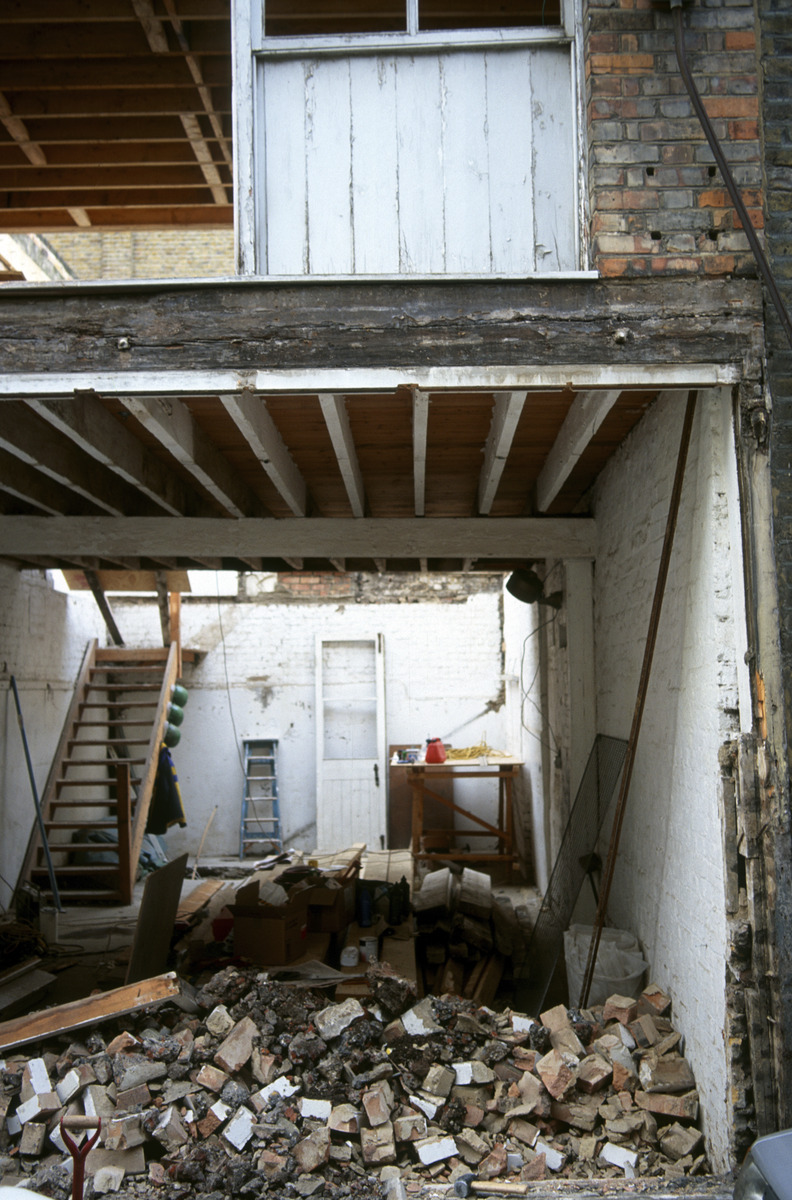
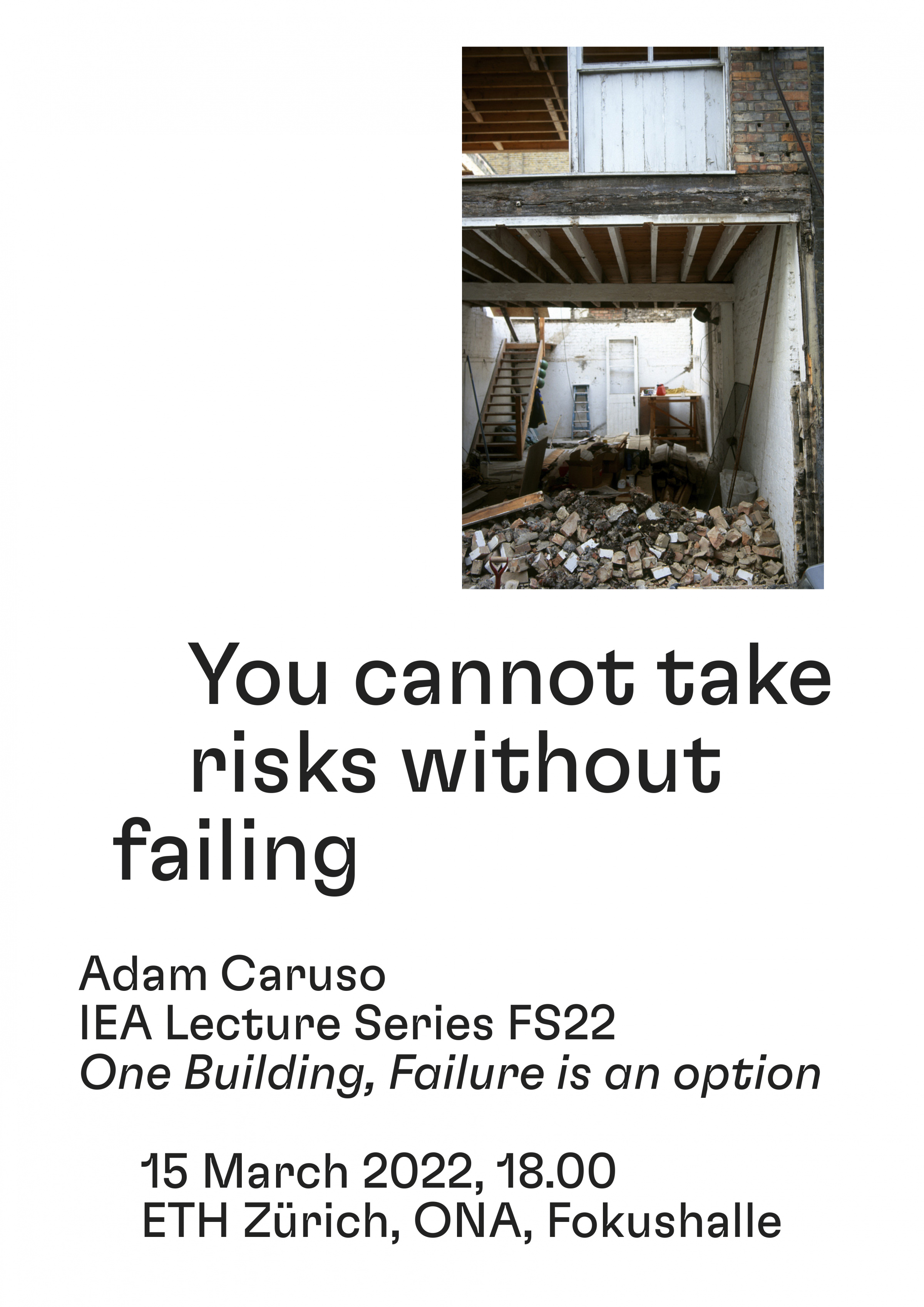
Adam Caruso
IEA Lecture Series FS 22
One Building, Failure Is an Option
ETH Zürich, ONA, Fokushalle
Interim, forever


Projekt Interim Waldhaus


Diploma HS 2021


Chair of Architecture and Construction
Adam Caruso
The project is presented as a folder, a collection of stories, architectural details, and material understanding, to provide information about the handling of the building and propose a resource for an ongoing transformation. The pages and stories can be rearranged, offering multiple readings and interpretations of the building, architectural fragments, and the interventions.
The research project engages with the hotel building known as Marriott that opened in the 1970s as an autonomous object in the city center of Zurich.The research unfolded stories about the building from contact with the original architect of the building, the interior designers, and the Head of Engineering who has worked in the building for over 25 years. Since the opening of the hotel, the idea of a «complete work of art» has been defiant. Over the years, the building underwent numerous modifications and transformations, revealing mutable versions of itself to keep up with the changing trends in hotel architecture.The generic new interiors have alienated the building’s interior from its shell. Each trend lasts for a generation and is custom- made for international hotel guests.The real users of the building, the workers, are thereby overlooked.The spatial separation between the front and back of the house is disproportionate.
The light touch aims to transform unused or historically interesting spaces in the hotel by critically reframing the existing layers and instrumentalising what is there.The actions are planned following the skill and expertise of the Engineering Team members of Marriott who have been in charge of every change ever made. Each space is appropriated to a new programme to tell the stories I encountered and reveal (im)material values that the building holds. Old, intermediate, and new layers create new atmospheres that are characterful to reconnect the hotel to its users and stay relevant in the future.


Women Writing Architecture
Website Launch
June 30, 2021
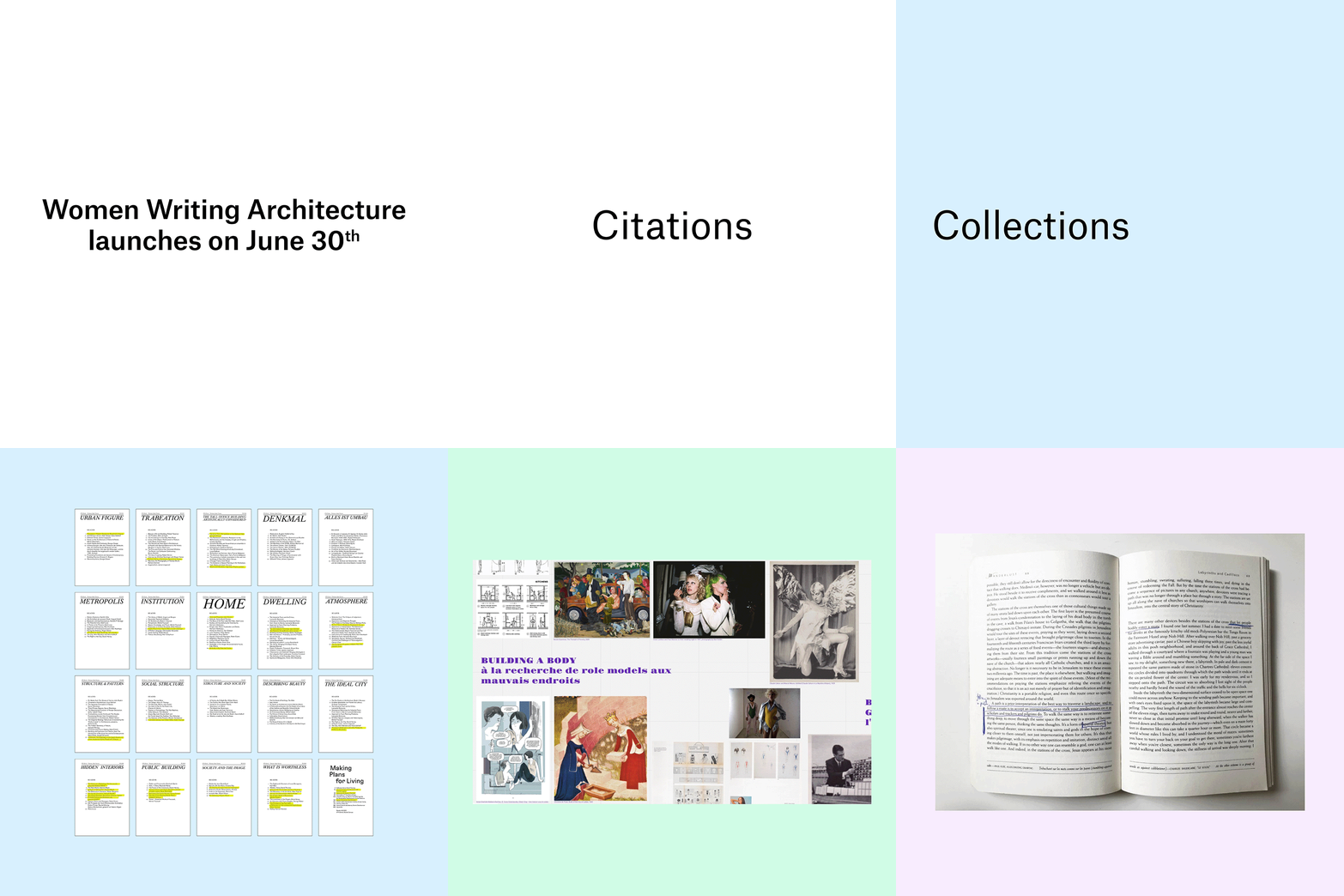
The website womenwritingarchitecture.org was launched this week on June 30th. The new resource, an annotated bibliography of writing by women about architecture, is now publicly accessible to discover, browse and contribute to.
Making Plans for Living Together


The project explores the relationship of existing and intervention, the simultaneity of the market and storage as the current program and the sports center as a new form of cultural use are thematised and spatially intertwined.
Juxtaposition as an instrument to create complexities and contradictions. The tran- sitions between old and new, temporary and permanent, are consciously negated, leading to a new relationship of coexisting spaces without the enforcement of any external changes to the existing building.

Nora Schibli / Yagmur Kültür
FS 2021 Making Plans for Living Together, Zürich


Melliodora, Hepburn Permaculture Gardens


Making Plans for Living
Leslie Majer / Félicie Morard
HS 2020 Making Plans for Living, Zürich


Ragamala, Indian Miniatures


Re-Use Ciba


The task of re-using Ciba triggered two main questions in me: Firstly, what meaning the term re-use could signify and comport and secondly, what constitutes the identity of a place.
The concept of circular economy possesses a high potential regarding the problems and questions of the CIBA areal. It is about thinking the economy in circular processes, i.e. sharing, leasing, reusing, repairing, reconditioning, and finally recycling products and materials. The average demolition of ten houses in Switzerland per day and construction waste’s share of four-fifths of the total Swiss waste proves how vital circular thinking is to future architecture.
By designing the component catalogue, we can give the materials used in the Ciba Buildings an identity and therefore seeing them as a resource. However, in addition to recognising the material value, the value of the work needed to produce the component must also be considered. A building component can be looked at as an accumulation of materials, working processes, assembling operations and production design steps.
The goal of the intervention is to turn the Bau610, the former canteen of CIBA, with minimal interventions in an accessible productive space. The main task of the building is the circulation, i.e. the access for city residents and the movement of the building components.
The building components of dismantled structures are delivered, stored, processed, and distributed again. For this purpose the roof and the basement are connected by a crane in the north and a stair tower with a goods lift facing south.
The new structures are „dressed“ by the ever-changing components stored in the building and display the material accumulation and continuous process.
In this project there isn’t a finished designed building but a proposal for a way of thinking about architecture and the built environment. Instead of production- and consumption-oriented architecture we should advocate circular processes in the architecture and the building industry.
To conclude with a quote of Thomas Hirschhorn, a contemporary artist that greatly inspired this design process : “It is not about re-using, it is about working with what is there”.
What is it worth?


Welche Heimat?
Tobias Wagner
HS 2019 Welche Heimat?


Society and the Image
Alica Clemens / Dario Weibel
HS 2019 Society and the Image, Zürich


Download Booklets


Public Building
Timothy Bauer / David Butler
FS 2019 Public Building, Zürich


Rusakov Workers’ Club, Konstantin Melnikow
Moskau, 1928


Hidden Interiors
Turi Colque Lajo / Tanja Kern
HS 2018 Hidden Interiors, Zürich


Villa Medici, Leon Battista Alberti
Fiesole, 1457


The Ideal City
Lisa Maillard / Salome Rohner
FS 2018 The Ideal City, Albisgüetli


Highrise City, Ludwig Hilbeseimer
1924


Describing Beauty
Noh Masks
Japan, 1700


Structure and Society
Saida Brückner / Melanie Underhill
FS 2017 Structure and Society, Zürich


Atlanpole, Hans Kollhoff
Nantes, 1988


Social Structure
Kathrin Röthlisberger / Corinne Räz
HS 2016 Social Structure, Graubünden


Politics & Demographics
Graubünden


